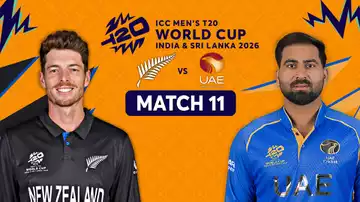
The ICC Men’s T20 World Cup 2026 has already delivered its first major statement of dominance. In the 11th match of the tournament, held at the iconic MA Chidambaram Stadium in Chennai, New Zealand didn’t just win; they dismantled the United Arab Emirates (UAE) in a performance that rewritten the history books.
What happens when a seasoned cricketing powerhouse meets an ambitious Associate nation on a spin-friendly deck? Usually, a grind. But on February 10, 2026, the world witnessed a surgical strike by the Blackcaps. Chasing a respectable target of 174, New Zealand’s openers turned the game into a highlight reel, securing a 10-wicket victory with nearly five overs to spare.
The Toss: UAE Sets The Stage For A Challenge
Under the humid Chennai sky, UAE captain Muhammad Waseem won the toss and made the brave call to bat first. Historically, the “Chepauk” surface favors spinners as the game progresses, making the choice to set a target a logical one. Waseem’s intent was clear: put runs on the board and let the slower bowlers choke the Kiwis under the lights.
New Zealand captain Mitchell Santner admitted he would have also preferred to bat, but he looked confident in his bowling unit. The Blackcaps entered the match with momentum following a win against Afghanistan, while the UAE was making its tournament debut, looking to repeat their 2023 upset over the Kiwis.
UAE First Innings: A Valiant Effort On The Big Stage
The UAE innings was a tale of two halves. They began with a stutter but found their rhythm through a record-breaking partnership that briefly threatened the New Zealand bowling attack.
The Powerplay And The Sharafu Show
The UAE lost opener Aryansh Sharma early to Jacob Duffy, but what followed was a masterclass in fearless cricket. Alishan Sharafu and Muhammad Waseem stitched together a brilliant 107-run partnership for the second wicket.
- Alishan Sharafu: He played with a blend of innovation and power, reaching his 50 in just 39 balls. His upper-cut over point against the Kiwi pacers was easily the shot of the afternoon.
- Muhammad Waseem: The skipper anchored the innings with a composed 66 off 45 balls. His ability to find the gaps during the middle overs kept the scoreboard ticking at over 8 runs per over.
The Kiwi Fightback
Just as the UAE looked poised to cross the 190-mark, New Zealand’s experience came to the fore. Daryl Mitchell pulled off a stunning relay catch at the boundary to dismiss Sharafu, providing the breakthrough New Zealand desperately needed.
From 119/1, the UAE innings lost some steam. Mitchell Santner bowled a disciplined spell (1/23), and Matt Henry (2 wickets) utilized his variations to prevent a late-inning explosion. The UAE finished at 173/6, which was their highest-ever total in a T20 World Cup match—a proud moment for the Associate nation.
The Run Chase: New Zealand’s Brutal Efficiency
If the UAE felt they had a “fighting total,” the New Zealand openers had other plans. What followed was not a chase; it was a demolition. Finn Allen and Tim Seifert didn’t just cross the line; they sprinted past it, setting a new record for the highest successful chase in T20 World Cup history without losing a wicket.
Power-Hitting At Its Finest
From the first over, Finn Allen signaled his intentions by dancing down the track. Tim Seifert, not to be outdone, matched him stroke for stroke.
| Batter | Runs | Balls | 4s | 6s | Strike Rate |
| Tim Seifert | 89* | 42 | 12 | 3 | 211.90 |
| Finn Allen | 84* | 50 | 5 | 5 | 168.00 |
Statistical Breakdown Of The Chase
- Powerplay Dominance: The Kiwis raced to 78/0 in the first 6 overs.
- Target Achieved: 175/0 in just 15.2 overs.
- The Finish: Tim Seifert sealed the game with a towering maximum, leaving the UAE bowlers searching for answers.
The UAE bowling attack, led by Junaid Siddique and Muhammad Rohid Khan, struggled to find a consistent length. The humidity made it difficult to grip the ball, and the Kiwi openers exploited the shorter side of the boundaries with clinical precision.
Key Moments And Tactical Analysis
Why Did The UAE Bowlers Struggle?
While the UAE batters did their job, the bowlers failed to execute the plans. Muhammad Waseem noted in the post-match presentation that they were “15-20 runs short,” but the reality was the lack of wicket-taking threat. The red soil of Chennai offered some bounce, but without movement, Allen and Seifert were able to play through the line.
The Santner Factor
Mitchell Santner’s captaincy was spot on. He rotated his bowlers effectively, using Glenn Phillips and Rachin Ravindra to fill the gaps. By keeping the UAE to 173, he ensured his batters weren’t under scoreboard pressure, allowing them to play their natural, aggressive game.
Post-Match Statistics And Calculations
To understand the magnitude of this win, we look at the Net Run Rate (NRR) implications.
NRR Impact Calculation
New Zealand’s NRR skyrocketed after finishing the chase in just 15.2 overs.
If we define the Run Rate ($RR$) as:
$$RR = \frac{\text{Total Runs}}{\text{Total Overs}}$$
New Zealand’s RR for this match:
$$RR_{NZ} = \frac{175}{15.33} \approx 11.41$$
Compared to UAE’s RR:
$$RR_{UAE} = \frac{173}{20} = 8.65$$
This massive gap ensures New Zealand stays at the top of Group D, effectively securing a comfortable path toward the Super 8s.
Frequently Asked Questions (FaQs)
1. Who won the Man of the Match award?
Tim Seifert was named Player of the Match for his blistering 89* off 42 balls, marking his second consecutive fifty in the 2026 World Cup.
2. Is 175/0 a new World Cup record?
Yes. It is now the highest successful run chase in T20 World Cup history without losing a single wicket, surpassing the previous record held by England against India (170/0) in 2022.
3. What is the next match for New Zealand?
New Zealand will travel to Ahmedabad to face South Africa in a highly anticipated clash that could decide the group topper.
4. How can the UAE qualify for the next round?
The UAE must win their remaining games against Canada and other group opponents while hoping for favorable results elsewhere to keep their Super 8 dreams alive.
Conclusion: A Warning To The Rest Of The World
The 11th match of the 2026 T20 World Cup was a masterclass in “Clinical Cricket.” New Zealand proved that they are not just “dark horses” anymore—they are frontrunners. For the UAE, the game was a bittersweet experience; they proved they could bat with the best, but their bowling and fielding require urgent refinement for the international stage.
As the tournament progresses, the “Blackcaps” look like a well-oiled machine. With Allen and Seifert in this kind of form, can any bowling attack truly feel safe?